Academic Emergency Medicine
- Abx reduce complications in culture positive asymptomatic bacteriuria, which is a subset of asymptomatic bacteriuria before culture performed.
- Uptodate makes no mention of checking UA in pregnant patients with abnormal vaginal bleeding. I was taught in residency to do this to rule out occult UTI as a cause of threatened miscarriage, then the UA always comes back with a few wbcs or bacteria and I feel obliged to treat. I’m gonna stop!
Ankle– brachial index for diagnosis of arterial injury in penetrating extremity trauma
- ABI not good enough by itself to rule out vascular injury but if ABI normal (>0.9) and no hard signs then you are done.
- ABI performed by measuring normal brachial cuff systolic bp and dividing by systolic bp measured at the ankle with the cuff just above the malleoli.
- Eastern Association of Surgery in Trauma guideline says:
- patients with hard signs go to the OR
- patients with no hard signs, a normal exam and a normal ABI (>0.9) may be discharged (proximity to a vessel not enough to do CTA).
- patients without hard signs but with an abnormal exam or ABI should get CTA.
American Journal of Emergency Medicine
None this month
Annals of Emergency Medicine
- Ketamine 6 minutes vs Haldol 5mg Midazolam 5mg 15 minutes
- ED clinicians had only moderate agreement with research HEART scores. Combined with uncertainties regarding accuracy in predicting major adverse cardiac events, we urge caution in the widespread use of the HEART score as the sole determinant of ED disposition.
- Droperidol 5mg and Olanzapine (Zyprexa) 10mg achieved sedation in same time 16 minutes with same side effect incidence
BMJ
None this month
Circulation
Myocarditis With COVID-19 mRNA Vaccines
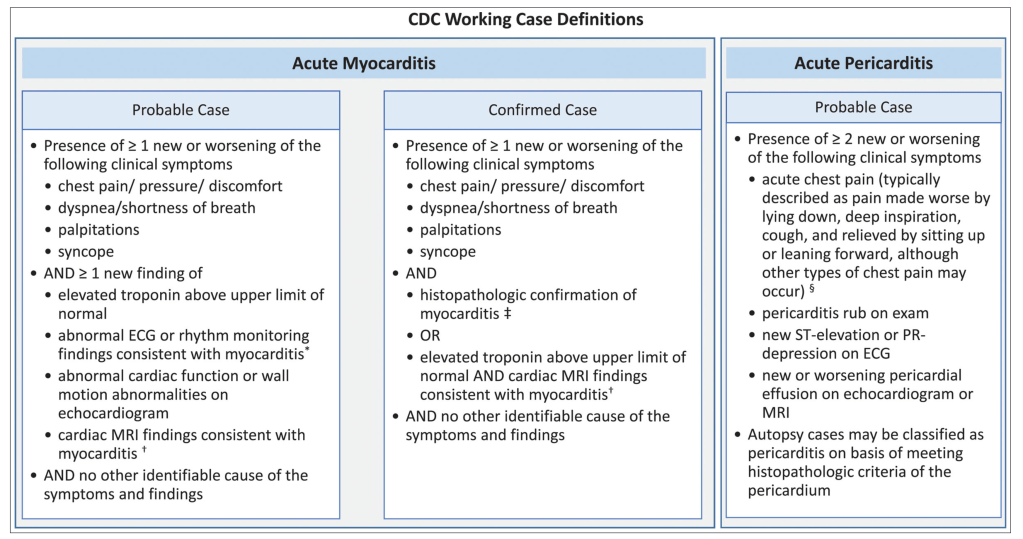
Diagnosis and Management of Myocarditis in Children
EMCRIT
None this month
Emergency Medicine Journal
EMRAP
Pediatric Pearls- Insulin Pumps
JAMA
None this month
NEJM
Case 24-2021: A 63-Year-Old Woman with Fever, Sore Throat, and Confusion
Therapeutic Anticoagulation with Heparin in Critically Ill Patients with Covid-19
Therapeutic Anticoagulation with Heparin in Noncritically Ill Patients with Covid-19
- Showed a benefit to therapeutic anticoagulation in non-critically ill but this benefit was small per Uptodate and other studies have not shown a benefit and the incidence of thromboembolic events in hospitalized patients are lower now than earlier in the pandemic, possibly related to the use of steroids and tocilizumab.
PEDIATRICS
Evaluation and Management of Well-Appearing Febrile Infants 8 to 60 Days Old
REBELEM
COVID-19 and Anticoagulation: Full Dose or Prophylactic Dose?
- In CRITICALLY ILL patients with COVID-19, an initial strategy of therapeutic-dose anticoagulation is not associated with a greater probability of survival to hospital discharge or a greater number of days free of cardiovascular or respiratory organ support vs usual-care pharmacologic thromboprophylaxis
- In NON-CRITICALLY ILL patients with COVID-19, an initial strategy of therapeutic-dose anticoagulation is associated with a greater probability of survival to hospital discharge or a greater number of days free of cardiovascular or respiratory organ support vs usual-care pharmacologic thromboprophylaxis
- In NON-CRITICALLY ILL patients with COVID-19, there is a clear signal of benefit, however with all the protocol violations and variable treatment arms it would still be reasonable to discuss with the inpatient team to help guide the decision (Although, in my practice and at my institution most patients who are not critically ill and don’t have contraindications, we have changed our protocols to full dose anticoagulation).
 Internet Book of Emergency Medicine