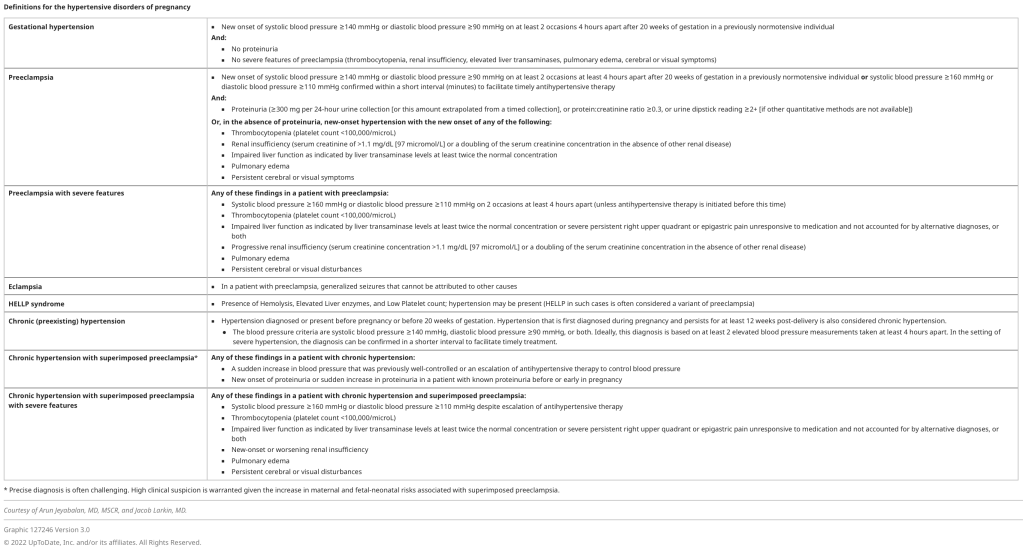
Gestational Hypertension
- New onset of systolic blood pressure ≥140 mmHg or diastolic blood pressure ≥90 mmHg on at least 2 occasions 4 hours apart after 20 weeks of gestation in a previously normotensive individual
And:
- No proteinuria
- No severe features of preeclampsia (thrombocytopenia, renal insufficiency, elevated liver transaminases, pulmonary edema, cerebral or visual symptoms)
Preeclampsia
- New onset of systolic blood pressure ≥140 mmHg or diastolic blood pressure ≥90 mmHg on at least 2 occasions at least 4 hours apart after 20 weeks of gestation in a previously normotensive individual or systolic blood pressure ≥160 mmHg or diastolic blood pressure ≥110 mmHg confirmed within a short interval (minutes) to facilitate timely antihypertensive therapy
And:
- Proteinuria (≥300 mg per 24-hour urine collection [or this amount extrapolated from a timed collection], or protein:creatinine ratio ≥0.3, or urine dipstick reading ≥2+ [if other quantitative methods are not available])
Or, in the absence of proteinuria, new-onset hypertension with the new onset of any of the following:
- Thrombocytopenia (platelet count <100,000/microL)
- Renal insufficiency (serum creatinine of >1.1 mg/dL [97 micromol/L] or a doubling of the serum creatinine concentration in the absence of other renal disease)
- Impaired liver function as indicated by liver transaminase levels at least twice the normal concentration
- Pulmonary edema
- Persistent cerebral or visual symptoms
Preeclampsia with severe features
Any of these findings in a patient with preeclampsia:
- Systolic blood pressure ≥160 mmHg or diastolic blood pressure ≥110 mmHg on 2 occasions at least 4 hours apart (unless antihypertensive therapy is initiated before this time)
- Thrombocytopenia (platelet count <100,000/microL)
- Impaired liver function as indicated by liver transaminase levels at least twice the normal concentration or severe persistent right upper quadrant or epigastric pain unresponsive to medication and not accounted for by alternative diagnoses, or both
- Progressive renal insufficiency (serum creatinine concentration >1.1 mg/dL [97 micromol/L] or a doubling of the serum creatinine concentration in the absence of other renal disease)
- Pulmonary edema
- Persistent cerebral or visual disturbances
Eclampsia
- In a patient with preeclampsia, generalized seizures that cannot be attributed to other causes
HELLP Syndrome
- Presence of Hemolysis, Elevated Liver enzymes, and Low Platelet count; hypertension may be present (HELLP in such cases is often considered a variant of preeclampsia)
Chronic Hypertension
- Hypertension diagnosed or present before pregnancy or before 20 weeks of gestation. Hypertension that is first diagnosed during pregnancy and persists for at least 12 weeks post-delivery is also considered chronic hypertension.
- The blood pressure criteria are systolic blood pressure ≥140 mmHg, diastolic blood pressure ≥90 mmHg, or both. Ideally, this diagnosis is based on at least 2 elevated blood pressure measurements taken at least 4 hours apart. In the setting of severe hypertension, the diagnosis can be confirmed in a shorter interval to facilitate timely treatment.
Chronic hypertension with superimposed preeclampsia
Any of these findings in a patient with chronic hypertension:
- A sudden increase in blood pressure that was previously well-controlled or an escalation of antihypertensive therapy to control blood pressure
- New onset of proteinuria or sudden increase in proteinuria in a patient with known proteinuria before or early in pregnancy
Chronic hypertension with superimposed preeclampsia with severe features
Any of these findings in a patient with chronic hypertension and superimposed preeclampsia:
- Systolic blood pressure ≥160 mmHg or diastolic blood pressure ≥110 mmHg despite escalation of antihypertensive therapy
- Thrombocytopenia (platelet count <100,000/microL)
- Impaired liver function as indicated by liver transaminase levels at least twice the normal concentration or severe persistent right upper quadrant or epigastric pain unresponsive to medication and not accounted for by alternative diagnoses, or both
- New-onset or worsening renal insufficiency
- Pulmonary edema
- Persistent cerebral or visual disturbances
 Internet Book of Emergency Medicine